
- Abortion (Medical Termination of Pregnancy / MTP)
- Understanding Medical Termination of Pregnancy (MTP)
- Choice between Medical Abortion and Surgical Abortion
- Places where MTP can be performed
- Advantages of Medical Abortion
- Disadvantages of Medical Abortion
- When to Seek Medical Care during a Medical Abortion?
- Surgical Abortion
- Disadvantages of Surgical Abortion
- Recovery Time for Abortion
- Pre-Abortion Examinations
- Post-Abortion Recovery Procedure

Medically Reviewed by Dr. Niraj Mahajan, MD, Gynecologist in Mumbai
This content has been reviewed by Dr. Niraj Mahajan, a specialist in cosmetic gynecology, ensuring that it is medically sound and up-to-date.
Abortion (Medical Termination of Pregnancy / MTP)
Undergoing an abortion or medical termination of pregnancy is a deeply personal and often challenging experience. Your gynecologist near me can make a significant difference, offering not just expert care but also a compassionate approach that prioritizes both your physical well-being and mental comfort. With specialized knowledge in gynecological health and care, the Best MTP abortion clinic in Mumbai can ensure that you receive the support you need during this sensitive time, helping you heal both physically and emotionally.
Understanding Medical Termination of Pregnancy (MTP)
What is MTP or Abortion?
Medical Termination of Pregnancy (MTP) is an abortion that safely terminates an early pregnancy through a combination of medications or minor surgery. These
medicines work by halting the pregnancy’s development and triggering the
shedding of the uterine lining. Only 2% to 5% of individuals who undergo an MTP
may require additional follow-up treatment to fully complete the process.
Medical Termination of Pregnancy refers to the legal method of abortion which
is done intentionally, during early to mid-pregnancy. In India, as per the
revised MTP Act (2021), it allows abortion/MTP to be performed till 24 weeks of
pregnancy.
Types of Abortion
There are two methods available for performing an abortion:
Medical Abortion
Non-surgical abortion in which medicines or medical abortion pills are used to induce abortion.
Surgical Abortion
Use of surgical procedures for terminating pregnancy, including vacuum aspiration, and dilatation and evacuation (D&E).
Choice between Medical Abortion and Surgical Abortion
- <= 9 weeks – Medical abortion or Surgical termination of pregnancy as an outpatient procedure.
- 9-13 weeks – Surgical abortion
- 13 – 24 weeks – Medicines with or without a surgical procedure as inpatient.
- For pregnancy is <= 7 weeks; medical method has a success rate of up to 97%.
- Surgical abortion is often recommended if the patient wishes to undergo concurrent procedures such as tubal ligation or the insertion of an IUCD (CuT).
- Final choice of medical or surgical abortion is offered to the pregnant woman after explaining the pros and cons of each procedure.
Places where MTP can be performed
- MTP center approved by the government to work according to the MTP Act.
- Medical abortion can be carried out at a clinic; however, the doctor must be affiliated with a government-approved MTP center.
Advantages of Medical Abortion
- Medical abortion avoids a surgical procedure and anesthesia.
- No need for admission to the hospital.
- Usually well tolerated by women if properly counseled and motivated.
- There is no need to take leave from work, as bleeding can be managed with menstrual pads even while at the office or during work.
Disadvantages of Medical Abortion
- Medical abortion takes time (days) to complete the abortion, and the timing may not be predictable.
- Women may experience bleeding and cramping, along with potential side effects such as nausea, vomiting, fever, and shivering.
- May require more clinic visits than surgical termination of pregnancy.
- Success rate is high but not 100%.
- In rare cases, the abortion may be incomplete, requiring a follow-up surgical procedure.
- Additionally, emotional distress is possible, as the process involves passing the pregnancy at home.
When to Seek Medical Care during a Medical Abortion?
Your doctor will guide you on how to care for yourself in the days following an abortion. Some self-care tips may include:
- Taking over-the-counter anti-inflammatory medication to ease cramps (your doctor can prescribe stronger medication if needed).
- Using hot packs for comfort.
- Gently massaging the affected area for pain relief.
To reduce the risk of infection during the first week, it’s advised to avoid:
- Inserting anything into your vagina, including tampons.
- Engaging in vaginal sex.
- Doing strenuous activities, including sports or heavy work, until the bleeding stops.
Swimming.
Your doctor will inform you about potential side effects and what to do if they arise.
Surgical Abortion
Advantages of surgical abortion
- Surgical abortion is a quick procedure.
- A complete abortion can be easily verified by examining the aspirated products of conception.
- Takes place in a hospital so sterilization (Family planning operation) or placement of an intrauterine device (IUD) may be performed at the same time during the procedure of surgical abortion or MTP.
- It can be performed under local anesthesia if the woman is properly motivated and counseled; however, it is usually performed under short general anesthesia.
Disadvantages of Surgical Abortion
- Surgical abortion requires instrumentation of the uterus.
- Small risk of uterine or cervical injury.
- Timing of abortion is controlled by the doctor and hospital.
- Anesthesia needs to be administered, thereby carrying a minimal risk.
- Most doctors perform this procedure under short general anesthesia.
- Woman needs to be in the hospital for at least 6 hours.
- The effect of sedation will be there throughout the day.
- You can join work after 1-2 days’ rest.
Recovery Time for Abortion
Recovery time after an abortion varies depending on the method used and individual health factors. For both medical abortion and surgical abortion, most people recover within a few days to a week. During recovery, it’s important to rest, follow your provider’s instructions, and monitor for any unusual symptoms. Full recovery, including the return of regular menstrual cycles, may take up to six weeks.
Pre-Abortion Examinations
Pre-abortion examinations are essential to ensure a safe and effective procedure. These typically include a medical history review, a physical exam, and an ultrasound to confirm the pregnancy’s location and duration. Blood tests may also be conducted to check your overall health, blood type, and haemoglobin levels. These assessments help your doctor determine the most appropriate abortion method for you and ensure that any underlying health conditions are managed before the procedure.
Post-Abortion Recovery Procedure
After MTP, you might experience some common side effects. These can include mild nausea, dizziness, or headache, as well as stronger-than-usual cramping pain. Bleeding typically begins within 24 hours in medical abortion process, which may be heavier than a normal period and include some large clots. Within 2 days, bleeding usually lightens to a level similar to a regular period, continuing for 3 to 7 days. Some irregular or prolonged bleeding can occur for up to 14 days, which is normal.
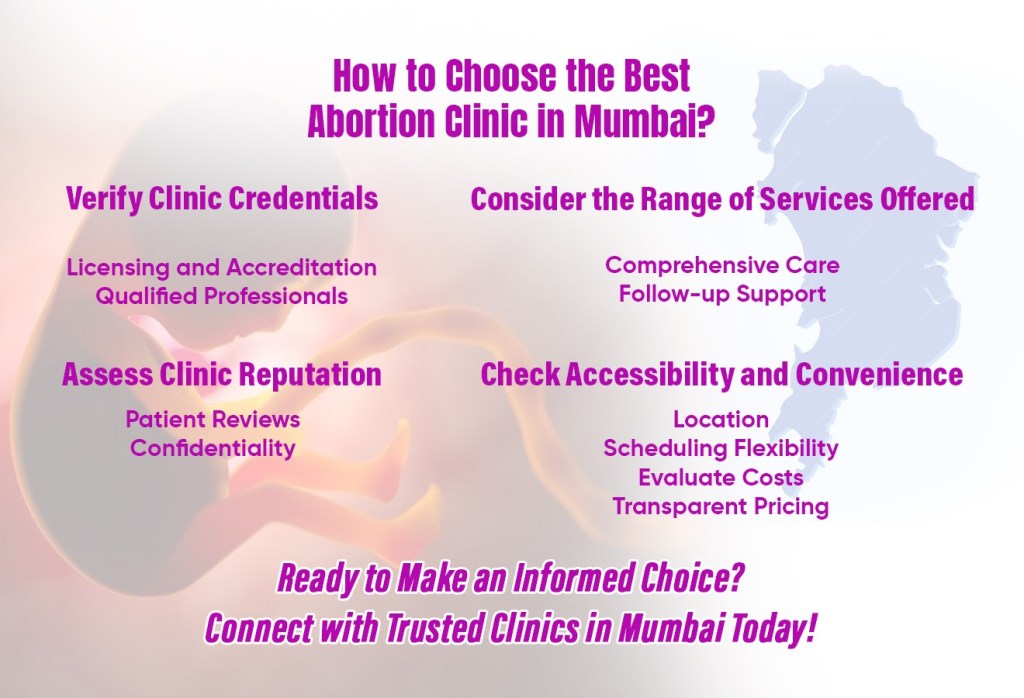
How to Choose the Best Abortion Gynaecologist in Mumbai?
Choosing the best gynecologist near me in Mumbai involves several key steps:
- Start by researching doctors with strong credentials and experience in abortion care.
- Look for specialists with a track record of successful outcomes and positive patient reviews.
- Ensure the gynecologist is up-to-date with the latest techniques and adheres to safety standards. Consider their approach to patient care, including their ability to provide clear, compassionate communication and personalized support.
- Verify that they offer a range of options and follow-up care.
FAQ
How much does an abortion cost in Mumbai?
The cost of medical abortions in Mumbai varies based on several factors. It can start from ₹5,000 INR for the medical abortion and around ₹50,000 INR for the surgical abortions.
How many weeks is safe for MTP?
This method can be initiated as soon as the pregnancy is diagnosed. In India, abortions are legally permitted up to 24 weeks of pregnancy.
When can a woman start having intercourse after an abortion?
Medical experts suggest waiting at least two weeks after an abortion before resuming sexual activity to reduce infection risk.
When will a woman get her next period after the abortion?
The first period typically occurs 4 to 6 weeks after an abortion. If it doesn’t happen within this timeframe, it’s important to consult a doctor and rule out another pregnancy.
Who is eligible to perform MTP?
In India, a medical practitioner who is registered in the State Medical Register can perform MTP.
Which clinics offer the safest abortion treatments in Mumbai?
Choosing the safest abortion treatments in Mumbai involves consulting experienced healthcare providers, considering medical vs. surgical options, and ensuring the clinic follows strict safety protocols. You need to prioritize professional guidance for optimal care.
Is MTP (Abortion) Legal in India?
In India, medical abortions are permitted up to 24 weeks of pregnancy. In India, abortions are governed by the Medical Termination of Pregnancy (MTP) Act of 1971.
How quickly can you become pregnant after an abortion?
An abortion does not impact fertility or future pregnancies. It’s possible to ovulate and become pregnant as soon as 2 weeks after the procedure.
Is it safe to terminate pregnancy at 6 weeks?
It is safest to terminate pregnancy early on. Abortion pills are most effective before 7 weeks. However, it can also be performed surgically using vacuum aspiration and/or dilatation and evacuation.
Continuous bleeding for 1 month after abortion pills?
Bleeding for one month after abortion pills is not normal. Bleeding may occur for 4 to 14 days after taking the pills. If bleeding still persists after 14 days, a gynecologist needs to be consulted immediately to confirm the completeness of abortion. Ultrasound will confirm if any products are remaining in the uterus. Retained products need to be removed surgically to prevent further complications like infection and infertility.